All posts tagged: Art

Movement is the Word

Sometime ago, I came across Mo Ibrahim’s keynote address at the Nelson Mandela Annual Lecture in Tshwane, South Africa. I listened as he pronounced that (and I paraphrase) ‘there will be no progress on the African continent until there is free movement of cultures, capital and people across borders.’ From his words, we can deduce that in many different sectors, not just in the arts, the freedom – or the lack of it – associated with movement plays a major role in the discourse on how to forge ahead in a continent burdened by the downsides of abundance and possibilities. This much is clear. But what seems rather foggy in this mad rush for movement and exploration of possibilities, is the question of direction. Where are we heading? Are we transcending limitations or are we merely circulating within them? These questions have come to form the driving force behind the endeavours of artists and thinkers who champion ‘movement.’ Perhaps the aim is not to arrive at a definite answer. Perhaps it suffices that the questions …
A Border Philosophy

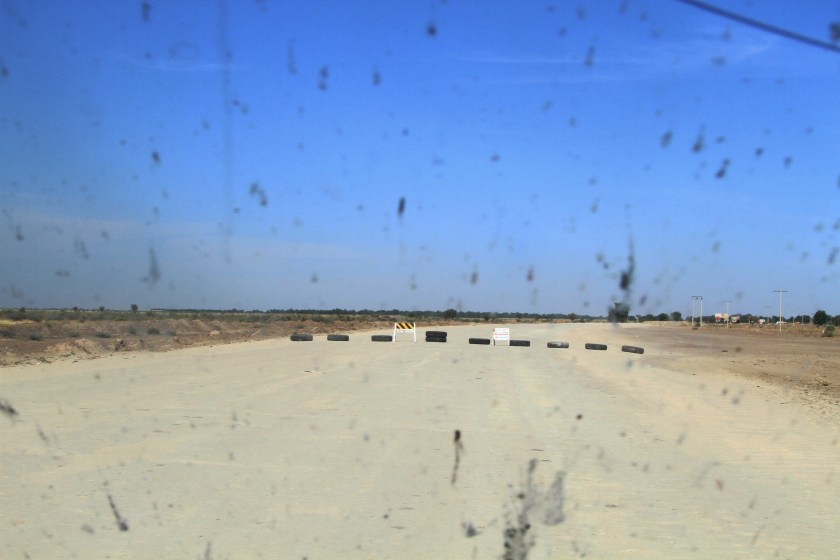
I was in conversation with a friend, breaking down thoughts around the question of borders. My point of deperture was that borders are not a stand-alone entity. It does not exist in a void, though they are of themselves a void – an illusion of tangibility. they are vacuum made tangible by the pressure that ensues from the negotiation of our differences. In one of Ursala Biemann’s film “performing the border“, the protagonist was heard saying that there will be no border if there are no “crossings”. The very notion of crossing carries within it the constituent character of a border. We can equally call this “the necessity of traversal” inherent in that which is the heartbeat of nature: movement.

From Accra With Love

It suffices to say that I am in Accra as I write. Yesterday we were out to Tawala beach where we convened as part of the IB Accra Project workshop. The idea is to have a sort of laid back afternoon reading and discussion around the works of some important thinkers and contributors to the African Critical Theory. We did – we read the likes of Reiland Rabaka, Mia Couto, Bonaventure Ndikung, and Emeka Okereke. We opened up on the topic of what is African? We deliberated on various point of views as to what Africa is, and what makes us Africans. Indeed, it was an interesting conversation session. I could invariably term it a feedback session for myself. It was rewarding to hear a few people caught within this African reality talk about how they perceive themselves in it. Take for example, Samuel Kolawole talked about finding the human essence rather than what labels we give to ourselves, be it African or whatever. Therefore to him Africa is a term still unresolved and to …

Discussing Aesthetics in The Trans-African Project

Reality can be synthesized I am sitting in a moderately furnished apartment, in the living room precisely. There is a flower vase right before me, on top of my desk – with flowers, yes. Only that these flowers are synthetic and not the real thing. It got me reflecting: The extent to which reality could easily be synthesized in a bid to approach or reproach its inherent substance… For more than 20 days, I have been on the road, together with eight other participants; we are artists – photographers, writers, filmmakers and even one who simply calls himself a visual artist.  The project is called Invisible Borders, and as the name seems to imply, it is all about rendering the Visible Borders invisible, flattening it, blurring it, but in actuality, the experiences gathered after three years and three editions of the trip, suggests that the name of the project could be seen at most as encompassing different layers and aspects, or at worst, a very vague term.

Diary of a Border-Bieng – Libreville Gabon

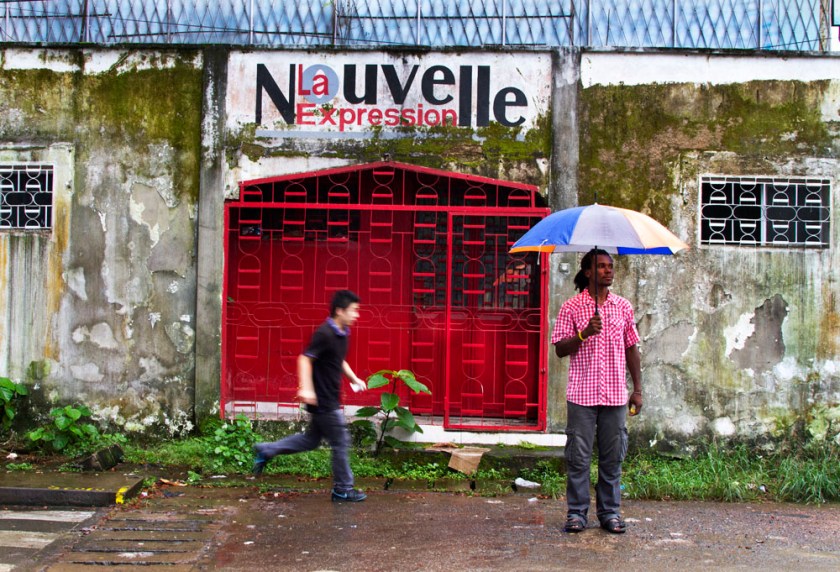
This morning, I woke up at some few minutes after 5.am. My head was pounding with a slight headache and for the umpteenth time, I slept in my clothes with my wallet and keys in my pocket. I woke up to the dawn of the morning in Libreville, and looked out the window. I was hit by a pleasant view accompanied by an equally pleasant feeling. That inner excitement that comes with being in a new place, the excitement of knowing who I was even though I didn’t know where I was. Sounds were a mishmash of speeding cars, and the crows of roosters, as if the city was in struggle with the countryside in attempt to determine which best represents it. But Libreville is a city of many facets. The rich are richer with the too-good-to-be- true cars and plush appearances, while the poor are very poor, minding their business mostly in the “quartier populaire” which is hardly the most popular part of the city.

Transcending "Africa"

In several terms, Africa has been bombarded with various nomenclatures in times past in efforts to define and sometimes cup its complexness. With vast stretches of lands, landscapes and intricate networks of people, making up one-sixth of the world’s population, that are constantly evolving, it is indeed understandable that it makes for concision to coin singular terms in order to abbreviate this ever dynamic continent and all that comes with it.